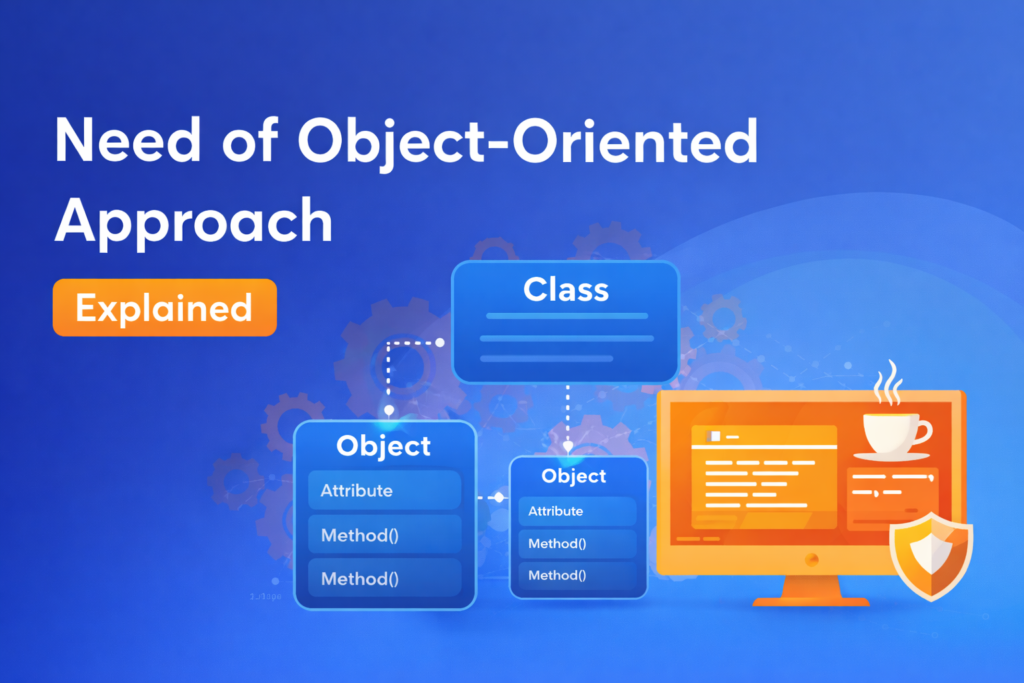
🧠 Need of Object-Oriented Approach
📌 Introduction
In the early days of programming, software systems were small and simple. As applications grew larger and more complex, traditional programming approaches started showing limitations. Managing large codebases, maintaining programs, and reusing existing code became increasingly difficult.
To overcome these challenges, the Object-Oriented Approach (OOA) was introduced. This approach organizes software around objects, making programs easier to design, understand, maintain, and extend.
🖥️ Limitations of Traditional Programming Approaches
⚠️ Problems with Procedural Programming
Procedural programming focuses on functions and procedures, rather than real-world entities. While suitable for small programs, it struggles with large systems.
Major limitations include:
- Poor code reusability
- Difficult maintenance
- Lack of data security
- Tight coupling between data and functions
- Complexity increases rapidly with program size
🧩 Example: Banking System (Procedural Approach)
In a procedural system:
- Account balance is a global variable
- Multiple functions can modify it
- Any change in logic affects many parts of the program
This leads to:
- Errors
- Unpredictable behavior
- Hard-to-maintain code
🌍 What Is the Object-Oriented Approach?
📘 Basic Idea
The Object-Oriented Approach models software based on real-world objects such as:
- Student
- Bank Account
- Car
- Employee
Each object:
- Contains data (attributes)
- Contains behavior (methods)
This approach closely matches how humans think about real-world systems.
🧱 Core Motivation Behind Object-Oriented Approach
🎯 Real-World Modeling
Object-oriented programming allows developers to model real-life entities directly in code.
Example:
- A Car object has:
- Attributes: speed, color, fuel
- Methods: start(), accelerate(), brake()
This makes the program intuitive and easier to design.
🔒 Data Security and Encapsulation
🛡️ Problem in Traditional Approach
Data is often:
- Globally accessible
- Modified unintentionally
- Difficult to protect
✅ Object-Oriented Solution
OOP uses encapsulation, which:
- Bundles data and methods together
- Restricts direct access to data
- Protects internal object state
Example:
- Bank balance cannot be modified directly
- Access is allowed only through deposit() or withdraw()
🔁 Code Reusability
📌 The Reuse Problem
In traditional programming:
- Code duplication is common
- Changes must be repeated in multiple places
♻️ OOP Solution: Reusability
Object-oriented programming promotes reuse using:
- Classes
- Inheritance
Example:
- A
Vehicleclass CarandBikeclasses reuse its features
This reduces development time and errors.
🔄 Flexibility and Extensibility
📌 Why Flexibility Matters
Software requirements change frequently:
- New features
- Modified business rules
- Technology updates
🧩 OOP Advantage
Using OOP:
- New functionality can be added without affecting existing code
- Existing classes can be extended
This ensures easy scalability.
🧠 Manageability of Large Systems
📦 Complexity Problem
Large applications contain:
- Thousands of lines of code
- Multiple developers
- Long development cycles
🧩 OOP as a Solution
Object-oriented approach:
- Breaks the system into manageable objects
- Encourages modular design
- Simplifies debugging and testing
Each object can be developed and tested independently.
📊 Comparison: Procedural vs Object-Oriented Approach
| Feature | Procedural Approach | Object-Oriented Approach |
|---|---|---|
| Focus | Functions | Objects |
| Data Security | Poor | Strong |
| Code Reusability | Limited | High |
| Real-World Mapping | Difficult | Easy |
| Maintenance | Hard | Easy |
| Scalability | Poor | Excellent |
🏢 Real-World Practical Examples
🏫 Example 1: Student Management System
Using OOP:
- Student is an object
- Attributes: rollNo, name, marks
- Methods: calculateGrade(), displayDetails()
Each student object works independently.
🏦 Example 2: Banking Application
Objects:
- Account
- Customer
- Transaction
This structure:
- Improves security
- Simplifies updates
- Reflects real banking operations
🚗 Example 3: Car Manufacturing Software
Objects:
- Engine
- Gearbox
- Wheels
Each component is an object with its own responsibilities.
❌ Common Misconceptions
🚫 Object-Oriented Programming Is Only for Java
❌ Incorrect
✔ OOP is a concept, used in many languages (C++, Python, Java)
🚫 OOP Is Too Complex
❌ Misunderstanding
✔ OOP simplifies large and complex systems
🧠 Simple Analogy to Understand the Need
📘 Real-World Analogy
- Procedural programming → One big instruction manual
- Object-oriented programming → A team of specialists, each handling a specific task
This division makes work efficient and manageable.
🎯 Why Modern Software Uses OOP
⭐ Key Benefits
- Natural real-world mapping
- Better security
- High reusability
- Easy maintenance
- Scalable architecture
- Team-friendly development
This is why most modern software systems adopt the object-oriented approach.
🏁 Conclusion
📝 Final Summary
The need for the object-oriented approach arises from the increasing complexity of modern software systems. By organizing programs around objects rather than procedures, OOP provides a structured, secure, reusable, and scalable way to build software.
Understanding the need for object-oriented programming lays a strong foundation for learning advanced concepts such as classes, objects, inheritance, polymorphism, and abstraction, which form the core of modern programming languages like Java.