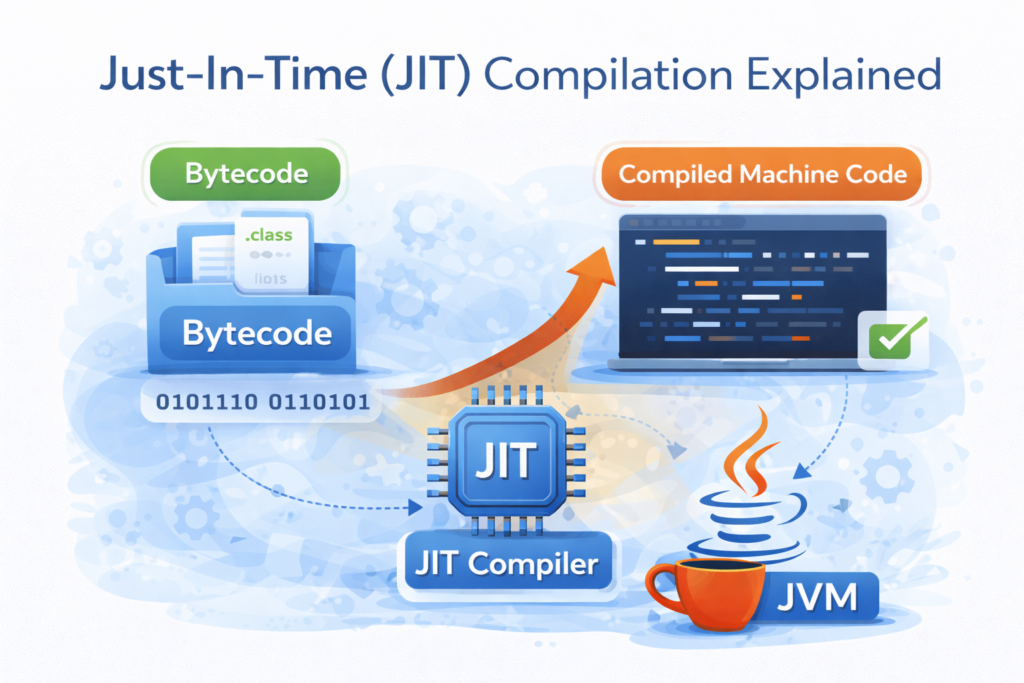
⚡ Just-In-Time (JIT) Compilation Explained
📌 Introduction
While learning Java, students often hear that Java is slow because it is interpreted. However, modern Java applications perform extremely well and are used in high-performance enterprise systems.
The key reason behind this performance improvement is Just-In-Time (JIT) Compilation.
This article explains what JIT compilation is, why it is required, and how it improves Java performance, in a clear and structured manner.
🧠 Why Normal Interpretation Is Not Enough
❌ Problem with Pure Interpretation
When Java bytecode is interpreted:
- Each instruction is translated every time it runs
- Execution becomes slower
- Repeated execution causes performance overhead
This approach is not efficient for large or frequently executed programs.
❌ Problem with Traditional Compilation
If Java were fully compiled into machine code:
- Platform independence would be lost
- Programs would need recompilation for each OS
Java needed a better solution.
🚀 What Is Just-In-Time (JIT) Compilation?
📌 Definition
Just-In-Time (JIT) Compilation is a technique where:
- Java bytecode is compiled into native machine code at runtime
- Only frequently executed code is compiled
- The compiled code is reused for faster execution
JIT is a part of the Java Virtual Machine (JVM).
🔄 Where JIT Fits in Java Execution
🧩 Java Execution Without JIT
- Java source code → compiled to bytecode
- JVM interprets bytecode line by line
- Same code interpreted repeatedly
Result: ❌ Slower execution
🧩 Java Execution With JIT
- Bytecode is interpreted initially
- JVM identifies hot code (frequently executed parts)
- JIT compiles hot code into native machine code
- Native code is reused
Result: ✅ Faster execution
🔥 What Is “Hot Code”?
📌 Meaning of Hot Code
Hot code refers to:
- Loops
- Frequently called methods
- Repeated instructions
The JVM monitors execution and decides which parts are worth compiling.
🧠 How JIT Works Internally
⚙️ Step-by-Step Working
- JVM starts executing bytecode using an interpreter
- JVM monitors execution frequency
- Frequently executed methods are marked as hot
- JIT compiles hot methods into native machine code
- JVM executes compiled native code directly
This process happens automatically.
🧱 Types of JIT Compilers in JVM
🔹 Client Compiler (C1)
- Faster compilation
- Less optimization
- Suitable for desktop applications
🔹 Server Compiler (C2)
- Advanced optimizations
- Slower compilation
- Better runtime performance
- Used in enterprise applications
Modern JVMs use both.
⚡ Key Optimizations Performed by JIT
🚀 Common Optimizations
- Method inlining
- Loop unrolling
- Dead code elimination
- Constant folding
- Escape analysis
These optimizations significantly improve performance.
📊 Comparison: Without JIT vs With JIT
| Feature | Without JIT | With JIT |
|---|---|---|
| Execution Speed | Slow | Fast |
| Repeated Code | Re-interpreted | Reused |
| Runtime Optimization | ❌ No | ✅ Yes |
| Performance Over Time | Constant | Improves |
| Suitability | Small programs | Large applications |
🌍 JIT and Platform Independence
🧠 Important Clarification
Even though JIT generates native machine code:
- It happens inside the JVM
- JVM is platform-specific
- Java bytecode remains platform independent
Therefore:
JIT does NOT break Java’s platform independence
❌ Common Misconceptions About JIT
🚫 JIT Compiles the Entire Program
❌ Incorrect
✔ JIT compiles only frequently executed parts
🚫 JIT Makes Java Fully Compiled
❌ Incorrect
✔ Java still uses bytecode and JVM
🚫 JIT Slows Down Startup
✔ Partially true
Initial execution may be slower, but performance improves over time.
🧠 Simple Analogy (Easy to Remember)
📘 Real-World Analogy
- Interpreter → Reading instructions every time
- JIT → Memorizing commonly used steps
Once memorized, tasks are done much faster.
📌 Why JIT Is Essential for Java
⭐ Key Benefits
- Improved runtime performance
- Optimized execution
- Efficient resource usage
- Scalability for large applications
- Enterprise-grade performance
JIT is one of the core reasons Java is still widely used.
🏁 Conclusion
📝 Final Summary
Just-In-Time (JIT) compilation is a powerful JVM feature that bridges the gap between interpretation and compilation. By converting frequently executed bytecode into native machine code at runtime, JIT significantly improves Java performance while preserving platform independence.
Understanding JIT helps learners appreciate how Java achieves both portability and efficiency, making it suitable for modern, large-scale software systems.