➗ Arithmetic Operators in Java
📌 Introduction
Operators are symbols that perform operations on variables and values. Among them, Arithmetic Operators are the most fundamental and are used to perform basic mathematical calculations.
Before learning conditions, loops, or expressions, it is essential to understand how arithmetic operators work internally, including common confusions and edge cases.
This article focuses only on Arithmetic Operators in Java, explained carefully with examples and common pitfalls.
🧠 What Are Arithmetic Operators?
📘 Definition
Arithmetic operators are used to perform mathematical operations such as addition, subtraction, multiplication, division, and remainder.
They work primarily with numeric data types like int, float, double, long, etc.
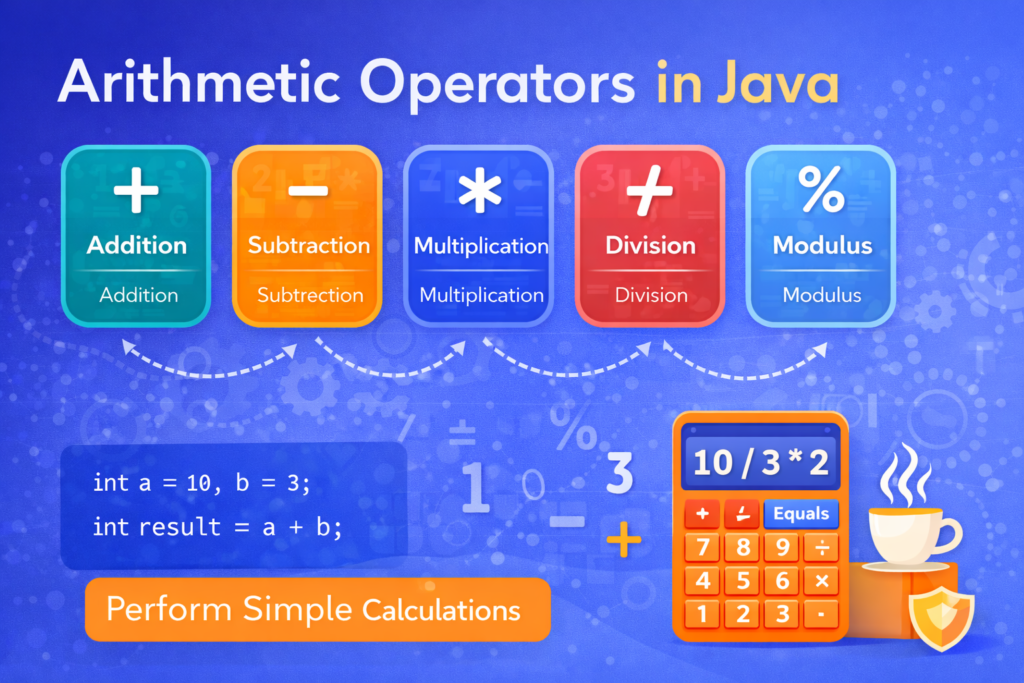
📊 List of Arithmetic Operators in Java
| Operator | Symbol | Operation |
|---|---|---|
| Addition | + | Adds two values |
| Subtraction | - | Subtracts one value from another |
| Multiplication | * | Multiplies values |
| Division | / | Divides one value by another |
| Modulus | % | Returns remainder |
➕ 1. Addition Operator (+)
📌 Basic Usage
The addition operator adds two operands.
int a = 10;
int b = 20;
int sum = a + b;
System.out.println(sum);
✔ Output:
30
⚠️ Common Confusion: Addition with Strings
int a = 10;
int b = 20;
System.out.println(a + b + "Java");
✔ Output:
30Java
But:
System.out.println("Java" + a + b);
✔ Output:
Java1020
🧠 Explanation:
+acts as addition for numbers+acts as concatenation for strings- Evaluation happens left to right
✅ Correct Thinking
Always use parentheses if mixing numbers and strings.
System.out.println("Result = " + (a + b));
➖ 2. Subtraction Operator (-)
📌 Basic Usage
Subtracts the second operand from the first.
int x = 20;
int y = 8;
System.out.println(x - y);
✔ Output:
12
⚠️ Confusion with Negative Numbers
int a = 10;
int b = -5;
System.out.println(a - b);
✔ Output:
15
🧠 Explanation:
Subtracting a negative value is equivalent to addition.
⚠️ Tricky Expression
int result = 10 - 5 - 2;
System.out.println(result);
✔ Output:
3
🧠 Explanation:
Evaluated left to right:
(10 - 5) - 2
✖️ 3. Multiplication Operator (*)
📌 Basic Usage
Multiplies two values.
int a = 6;
int b = 4;
System.out.println(a * b);
✔ Output:
24
⚠️ Confusion: Integer Multiplication Overflow
int a = 100000;
int b = 100000;
int result = a * b;
System.out.println(result);
✔ Output (unexpected):
1410065408
🧠 Reason:
inthas limited range- Result exceeds maximum limit
- Causes overflow
✅ Correct Way
long result = (long) a * b;
➗ 4. Division Operator (/)
📌 Basic Integer Division
int a = 10;
int b = 3;
System.out.println(a / b);
✔ Output:
3
🧠 Explanation:
- Integer division discards decimal part
- No rounding happens
⚠️ Common Confusion
System.out.println(10 / 4);
✔ Output:
2
Not 2.5.
✅ Correct Way to Get Decimal Result
System.out.println(10 / 4.0);
OR
System.out.println((double)10 / 4);
✔ Output:
2.5
⚠️ Division by Zero
int a = 10;
System.out.println(a / 0);
❌ Runtime Error:
ArithmeticException: / by zero
⚠️ But This Works
System.out.println(10.0 / 0);
✔ Output:
Infinity
🧠 Explanation:
Floating-point division follows IEEE standards.
➗ 5. Modulus Operator (%)
📌 Basic Usage
Returns the remainder of division.
System.out.println(10 % 3);
✔ Output:
1
🧠 Where Modulus Is Commonly Used
- Check even or odd
- Extract digits
- Cyclic operations
if (num % 2 == 0)
    System.out.println("Even");
⚠️ Confusion with Negative Numbers
System.out.println(-10 % 3);
✔ Output:
-1
🧠 Rule:
Remainder sign follows the dividend.
🔁 Modulus Without Using % (IMPORTANT)
📌 Mathematical Formula
a % b = a - (a / b) * b
🧪 Example
int a = 10;
int b = 3;
int rem = a - (a / b) * b;
System.out.println(rem);
✔ Output:
1
🧠 Why This Works
a / bgives quotient- Multiply quotient by divisor
- Subtract from original number
This is how hardware internally calculates remainder.
⚠️ Caution
This works correctly only for integer division logic. Care must be taken with negative values.
⚠️ Common Mistakes with Arithmetic Operators
❌ 1. Expecting Decimal from Integer Division
❌ 2. Ignoring Overflow
❌ 3. Mixing String and Arithmetic Without Parentheses
❌ 4. Using % Without Understanding Remainder Sign
❌ 5. Dividing by Zero
📊 Summary Table
| Operator | Key Point |
|---|---|
+ | Adds numbers or concatenates strings |
- | Subtracts values |
* | Can overflow for large integers |
/ | Integer division truncates decimal |
% | Returns remainder |
🎯 Why Arithmetic Operators Matter
⭐ Importance
- Foundation for expressions
- Used in conditions and loops
- Essential for problem solving
- Heavily tested in exams and interviews
Understanding arithmetic operators correctly prevents logical bugs early in programming.
🏁 Conclusion
📝 Final Summary
Arithmetic operators form the base of all computations in Java. While they appear simple, incorrect assumptions—especially with division, modulus, overflow, and type handling—can lead to unexpected results.
A clear understanding of how Java evaluates arithmetic expressions is essential before moving on to relational operators, logical operators, and control statements.