📘 Important Java Terminologies Explained
📌 Introduction
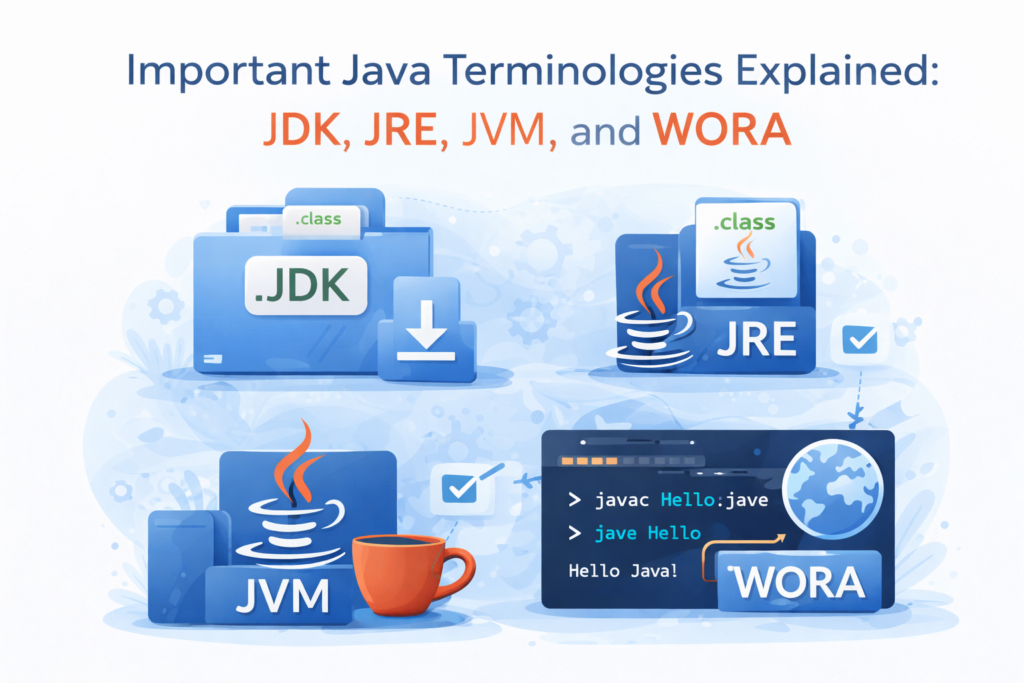
When learning Java, beginners often encounter several technical terms such as JDK, JRE, JVM, and WORA. These terms are fundamental to understanding how Java works internally and why it is considered a powerful and platform-independent programming language.
This article explains the most important Java terminologies in a clear, structured, and detailed manner, helping learners build a strong conceptual foundation.
☕ Java Programming Language
🧠 What Is Java?
Java is a high-level, object-oriented, platform-independent programming language developed by Sun Microsystems (now Oracle). It is widely used for building desktop applications, web applications, mobile apps, and enterprise systems.
Key characteristics of Java:
- Object-Oriented
- Platform Independent
- Secure
- Robust
- Multithreaded
🧱 Java Development Kit (JDK)
📦 What Is JDK?
The Java Development Kit (JDK) is a complete software package required to develop Java applications.
It contains:
- Java Compiler (
javac) - Java Runtime Environment (JRE)
- Java Development Tools
- Java Libraries
Without JDK, Java programs cannot be compiled.
🛠️ Purpose of JDK
- Writing Java programs
- Compiling source code into bytecode
- Running Java applications
- Developing enterprise and desktop applications
▶️ Java Runtime Environment (JRE)
📌 What Is JRE?
The Java Runtime Environment (JRE) provides the environment required to run Java programs.
JRE includes:
- Java Virtual Machine (JVM)
- Core Java libraries
- Supporting files
👉 JRE cannot compile Java programs.
📌 Key Point
If you only want to run Java applications, JRE is sufficient.
If you want to develop Java applications, JDK is required.
🧠 Java Virtual Machine (JVM)
⚙️ What Is JVM?
The Java Virtual Machine (JVM) is an abstract machine that executes Java bytecode.
It acts as a bridge between Java programs and the operating system.
Each operating system has its own JVM implementation.
🔄 Responsibilities of JVM
- Loading class files
- Verifying bytecode
- Executing bytecode
- Managing memory (Heap & Stack)
- Garbage collection
🌍 WORA – Write Once, Run Anywhere
📌 What Is WORA?
WORA stands for Write Once, Run Anywhere.
This means:
- Java code written on one platform
- Can run on any platform
- Without modification
This is possible because Java programs are compiled into bytecode, not machine code.
🧠 How WORA Works
- Java source code is compiled into bytecode
- Bytecode runs on JVM
- JVM converts bytecode into machine-specific instructions
🔄 Java Compilation and Execution Process
🧩 Step-by-Step Flow
.javafile → Java source codejavaccompiler → converts to.classfile (bytecode)- JVM loads
.classfile - JVM executes bytecode on the system
📊 Difference Between JDK, JRE, and JVM
| Feature | JDK | JRE | JVM |
|---|---|---|---|
| Used for Development | ✅ Yes | ❌ No | ❌ No |
| Used for Execution | ✅ Yes | ✅ Yes | ✅ Yes |
| Contains Compiler | ✅ Yes | ❌ No | ❌ No |
| Platform Independent | ✅ Yes | ✅ Yes | ✅ Yes |
| Includes JVM | ✅ Yes | ✅ Yes | ✔ Core |
🧪 Java Bytecode
📌 What Is Bytecode?
Bytecode is an intermediate code generated after compiling Java source code.
Characteristics:
- Not machine-specific
- Executed by JVM
- Enables platform independence
🧠 Java Class Loader
📌 What Is Class Loader?
The Class Loader is a part of JVM responsible for:
- Loading Java class files into memory
- Loading classes only when required
Types of Class Loaders:
- Bootstrap Class Loader
- Extension Class Loader
- Application Class Loader
🗑️ Garbage Collection
📌 What Is Garbage Collection?
Garbage Collection is an automatic memory management process in Java.
It:
- Removes unused objects
- Frees memory
- Prevents memory leaks
👉 Java developers do not manually free memory.
🔐 Java Security Manager
📌 What Is Security Manager?
The Java Security Manager controls access to system resources such as:
- File system
- Network
- Memory
- System properties
It ensures that Java applications run in a secure environment.
❌ Common Misconceptions About Java Terms
🚫 JDK and JRE Are the Same
❌ Incorrect
✔ JDK is for development
✔ JRE is for execution
🚫 JVM Is Platform Independent
❌ Incorrect
✔ JVM is platform dependent
✔ Java bytecode is platform independent
🚫 Java Is Slow
❌ Outdated belief
✔ Modern JVMs use JIT compilation
✔ Java performance is highly optimized
📌 When to Use What?
| Requirement | Use |
|---|---|
| Write Java programs | JDK |
| Run Java programs | JRE |
| Execute bytecode | JVM |
| Platform independence | WORA |
🏁 Conclusion
📝 Final Summary
Understanding Java terminologies such as JDK, JRE, JVM, and WORA is essential for mastering Java programming. These components work together to make Java secure, portable, and powerful.
A clear understanding of these concepts helps learners:
- Avoid confusion
- Debug issues effectively
- Build confidence while learning Java
This foundational knowledge is crucial before moving on to advanced Java topics.