📌 Introduction
Object-Oriented Programming (OOP) is a programming paradigm that organizes software design around objects rather than functions or logic alone. Each object represents a real-world entity and contains both data and behavior.
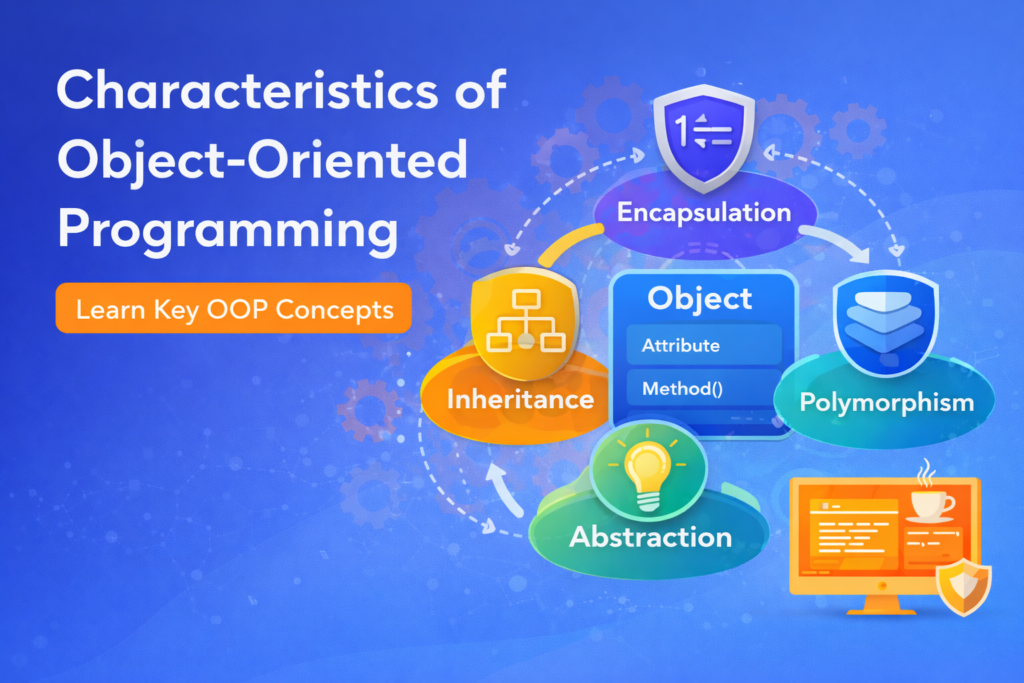
The strength of OOP lies in its core characteristics, which help in building secure, reusable, modular, and maintainable software systems. These characteristics form the foundation of modern programming languages such as Java.
🧱 1. Objects
📘 What Is an Object?
An object is a real-world entity that has:
- State (data)
- Behavior (methods)
🧪 Example
A Student object:
- Data: roll number, name, marks
- Behavior: calculateResult(), displayDetails()
Objects allow programs to represent real-life scenarios directly in code.
🧩 2. Classes
📘 What Is a Class?
A class is a blueprint or template used to create objects. It defines:
- Properties (variables)
- Functions (methods)
🧪 Example
A Car class defines:
- Data: speed, color, fuel
- Methods: start(), accelerate(), stop()
Multiple car objects can be created from the same class.
🔒 3. Encapsulation
📘 Meaning of Encapsulation
Encapsulation is the process of binding data and methods together and restricting direct access to data.
It helps in:
- Data protection
- Controlled access
- Preventing accidental modification
🧪 Real-World Example
A bank account:
- Balance is hidden
- Accessed only through deposit() and withdraw()
Encapsulation improves security and reliability.
🧬 4. Inheritance
📘 Meaning of Inheritance
Inheritance allows one class to reuse the properties and methods of another class.
It establishes a parent–child relationship.
🧪 Example
- Vehicle (parent class)
- Car and Bike (child classes)
Both reuse common features like speed and fuel.
Inheritance promotes code reusability and reduces duplication.
🔄 5. Polymorphism
📘 Meaning of Polymorphism
Polymorphism means one interface, multiple forms. The same method can behave differently in different contexts.
🧪 Example
- start() method:
- Car → starts engine
- Bike → starts ignition differently
Polymorphism improves flexibility and extensibility.
🧠 6. Abstraction
📘 Meaning of Abstraction
Abstraction focuses on what an object does, not how it does it.
It hides implementation details and shows only essential features.
🧪 Real-World Example
Using an ATM:
- User knows how to withdraw cash
- Internal banking logic is hidden
Abstraction reduces complexity and improves usability.
🔗 7. Dynamic Binding
📘 What Is Dynamic Binding?
Dynamic binding means that the method call is resolved at runtime, not at compile time.
🧪 Example
A parent reference pointing to a child object calls the child’s version of a method.
This supports runtime flexibility.
🧩 8. Message Passing
📘 Meaning of Message Passing
Objects communicate with each other by calling methods, known as message passing.
🧪 Example
An object sends a request to another object to perform an operation.
This improves modularity and interaction.
📊 Summary Table: Characteristics of OOP
| Characteristic | Purpose |
|---|---|
| Object | Represents real-world entity |
| Class | Blueprint for objects |
| Encapsulation | Data security |
| Inheritance | Code reuse |
| Polymorphism | Flexibility |
| Abstraction | Reduced complexity |
| Dynamic Binding | Runtime behavior |
| Message Passing | Object communication |
🎯 Why These Characteristics Matter
⭐ Key Advantages
- Natural problem modeling
- High code reusability
- Improved security
- Easy maintenance
- Scalable design
- Team-friendly development
These characteristics make OOP ideal for large and complex software systems.
🏁 Conclusion
📝 Final Summary
The characteristics of Object-Oriented Programming collectively provide a structured and efficient way to design software. By modeling programs around objects and their interactions, OOP simplifies development, improves code quality, and enhances maintainability.
A strong understanding of these characteristics is essential before learning advanced Java concepts such as classes, inheritance, interfaces, and polymorphism.