🔁 else-if Ladder in Java: Decision Making with Multiple Conditions
📌 Introduction
In real-world programs, decisions are rarely binary. Often, a program must choose one option out of many based on different conditions. The else-if ladder in Java is used exactly for this purpose.
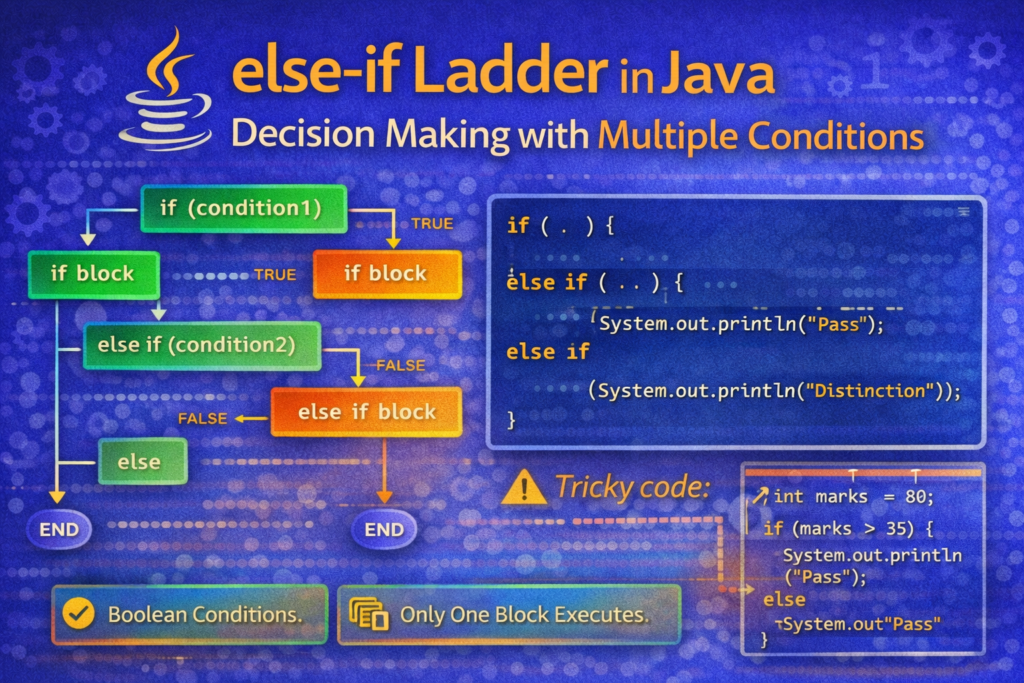
The else-if ladder allows checking multiple conditions sequentially, where only one block executes, corresponding to the first true condition.
🧠 What Is an else-if Ladder?
📌 Definition
An else-if ladder is a chain of if, else if, and an optional else statement used to test multiple conditions one after another.
Once a condition is satisfied:
- Its block executes
- The rest of the ladder is skipped
🧱 Syntax of else-if Ladder
📘 General Syntax
if (condition1) {
    // executes if condition1 is true
} else if (condition2) {
    // executes if condition2 is true
} else if (condition3) {
    // executes if condition3 is true
} else {
    // executes if all conditions are false
}
🔍 How else-if Ladder Works (Flow Explanation)
📌 Execution Flow
- Condition1 is checked
- If true → corresponding block executes → ladder stops
- If false → moves to condition2
- Process continues until:
- A condition becomes true, or
elseblock executes
👉 Only one block executes in the entire ladder.
🧪 Example 1: Grade Calculation Program
int marks = 82;

if (marks >= 75) {
    System.out.println("Distinction");
} else if (marks >= 60) {
    System.out.println("First Class");
} else if (marks >= 50) {
    System.out.println("Second Class");
} else if (marks >= 35) {
    System.out.println("Pass");
} else {
    System.out.println("Fail");
}
✔ Output:
Distinction
🧠 Explanation
marks >= 75→ true- Remaining conditions are not evaluated
⚠️ Very Important Rule (EXAM POINT)
In an else-if ladder, conditions are evaluated from top to bottom.
🔥 Tricky Example 1: Order of Conditions
int marks = 80;

if (marks >= 35) {
    System.out.println("Pass");
} else if (marks >= 75) {
    System.out.println("Distinction");
}
✔ Output:
Pass
❌ Logical mistake!
🧠 Why?
- First condition (
marks >= 35) is already true - More specific conditions are never reached
✔ Correct Order:
if (marks >= 75) {
    System.out.println("Distinction");
} else if (marks >= 35) {
    System.out.println("Pass");
}
⚠️ Common Mistakes Students Make
❌ Mistake 1: Using Multiple if Instead of else-if
if (x > 0) {
    System.out.println("Positive");
}
if (x > 5) {
    System.out.println("Greater than 5");
}
🧠 Both conditions may execute.
✔ else-if ensures only one block executes.
❌ Mistake 2: Missing Final else
Not adding else may leave no output for certain inputs.
❌ Mistake 3: Non-Boolean Conditions
if (marks) // compilation error
✔ Conditions must evaluate to boolean.
❌ Mistake 4: Using Assignment Instead of Comparison
if (x = 10) // compilation error
✔ Correct:
if (x == 10)
⚠️ Tricky Example 2: Confusing Braces
int x = 10;

if (x > 5)
    System.out.println("A");
else if (x > 8)
    System.out.println("B");
System.out.println("C");
✔ Output:
A
C
🧠 Only one statement belongs to each condition.
✔ Best Practice:
if (x > 5) {
    System.out.println("A");
} else if (x > 8) {
    System.out.println("B");
}
System.out.println("C");
⚠️ else-if vs Nested if (Important Distinction)
📌 else-if Ladder
- Mutually exclusive conditions
- Cleaner and more readable
- Preferred for ranges
📌 Nested if
- Used when conditions depend on previous checks
- More control, but can be complex
🧪 Example 3: Menu-Driven Program
int choice = 2;

if (choice == 1) {
    System.out.println("Add");
} else if (choice == 2) {
    System.out.println("Subtract");
} else if (choice == 3) {
    System.out.println("Multiply");
} else {
    System.out.println("Invalid choice");
}
✔ Output:
Subtract
🧠 Best Practices for else-if Ladder
✔ Arrange Conditions Carefully
- Specific → General
- Highest priority first
✔ Avoid Very Long Ladders
- Use
switchif comparisons are equality-based
✔ Always Use Braces
Improves readability and avoids logical errors
📘 Real-World Applications
- Grading systems
- ATM menu options
- Eligibility checks
- Pricing slabs
- Decision-based workflows
📌 Quick Summary
- else-if ladder handles multiple conditions
- Conditions are checked sequentially
- Only the first true block executes
- Order of conditions matters
- Cleaner than multiple
ifstatements
🏁 Conclusion
The else-if ladder is a powerful decision-making construct in Java that allows programs to handle multiple conditions efficiently. Understanding the evaluation order, avoiding common logical mistakes, and structuring conditions correctly are essential for writing reliable and readable Java programs. Mastery of else-if ladders forms a strong foundation for advanced control structures like switch statements.