🔍 Relational Operators in Java
📌 Introduction
Relational operators are used to compare two values and determine the relationship between them. Unlike arithmetic operators, which return numeric results, relational operators always return a boolean value — either true or false.
These operators are the foundation of decision-making in Java and are heavily used in:
ifstatements- loops (
for,while) - conditional expressions
Understanding relational operators clearly is essential before moving on to control statements.
🧠 What Are Relational Operators?
📘 Definition
Relational operators compare two operands and check whether a specific relationship exists between them.
✔ Result is always:
true or false
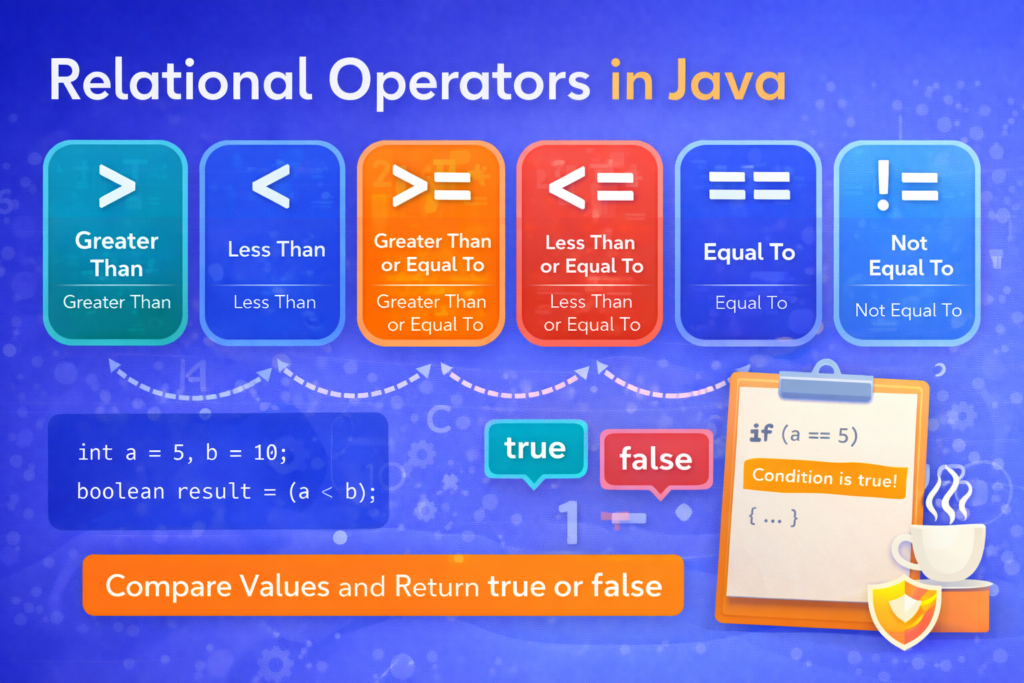
📊 List of Relational Operators in Java
| Operator | Meaning |
|---|---|
> | Greater than |
< | Less than |
>= | Greater than or equal to |
<= | Less than or equal to |
== | Equal to |
!= | Not equal to |
🔼 1. Greater Than Operator (>)
📌 Basic Usage
Checks whether the left operand is greater than the right operand.
int a = 10;
int b = 5;
System.out.println(a > b);
✔ Output:
true
⚠️ Common Confusion
System.out.println(5 > 10);
✔ Output:
false
🧠 Relational operators do not swap operands automatically.
⚠️ Tricky Case with Characters
System.out.println('b' > 'a');
✔ Output:
true
🧠 Reason:
Characters are compared using their Unicode values.
🔽 2. Less Than Operator (<)
📌 Basic Usage
int x = 3;
int y = 7;
System.out.println(x < y);
✔ Output:
true
⚠️ Tricky Expression
System.out.println(10 < 5 + 10);
✔ Output:
true
🧠 Arithmetic expressions are evaluated before relational operators.
🔼➖ 3. Greater Than or Equal To (>=)
📌 Basic Usage
int marks = 40;
System.out.println(marks >= 40);
✔ Output:
true
⚠️ Common Mistake
System.out.println(10 => 5); // INVALID
❌ Compilation Error
🧠 Operator must be written as >=, not =>.
🔽➖ 4. Less Than or Equal To (<=)
📌 Basic Usage
int age = 18;
System.out.println(age <= 18);
✔ Output:
true
⚠️ Confusion with Assignment
if (x = 10) // ERROR
❌ Compilation Error
🧠 Assignment (=) cannot be used inside conditions.
⚖️ 5. Equal To Operator (==)
📌 Basic Usage
Checks whether two values are equal.
int a = 5;
int b = 5;
System.out.println(a == b);
✔ Output:
true
⚠️ MOST COMMON CONFUSION (VERY IMPORTANT)
int a = 10;
if (a = 5) {
    System.out.println("Hello");
}
❌ Compilation Error
🧠 = is assignment, not comparison.
✔ Correct:
if (a == 5) {
    System.out.println("Hello");
}
⚠️ Tricky Case with Floating Point
double x = 0.1 + 0.2;
System.out.println(x == 0.3);
✔ Output:
false
🧠 Reason:
Floating-point numbers have precision issues.
✔ Correct approach:
System.out.println(Math.abs(x - 0.3) < 0.0001);
❌ 6. Not Equal To Operator (!=)
📌 Basic Usage
int a = 5;
int b = 7;
System.out.println(a != b);
✔ Output:
true
⚠️ Tricky Example
System.out.println(10 != 10);
✔ Output:
false
⚠️ Relational Operators with Non-Primitive Types (IMPORTANT)
❌ Wrong Way (Strings)
String s1 = "Java";
String s2 = "Java";
System.out.println(s1 == s2);
✔ Output:
true
⚠️ This works accidentally due to string pool.
❌ Dangerous Case
String s1 = new String("Java");
String s2 = new String("Java");
System.out.println(s1 == s2);
✔ Output:
false
🧠 == compares references, not content.
✔ Correct way:
System.out.println(s1.equals(s2));
⚠️ Common Compilation Errors & Mistakes
❌ 1. Using = instead of ==
❌ 2. Using relational operators with boolean incorrectly
System.out.println(true > false); // ERROR
❌ 3. Comparing incompatible types
System.out.println(10 > "Java"); // ERROR
❌ 4. Expecting relational operators to return numbers
int x = (10 > 5); // ERROR
Relational operators return boolean, not integers.
🧠 Operator Precedence Reminder
📌 Important Rule
Arithmetic operators are evaluated before relational operators.
System.out.println(10 + 5 > 12);
✔ Output:
true
📊 Summary Table
| Operator | Returns |
|---|---|
> | boolean |
< | boolean |
>= | boolean |
<= | boolean |
== | boolean |
!= | boolean |
🎯 Why Relational Operators Are Important
⭐ Key Importance
- Core of decision making
- Used in conditions and loops
- Foundation for logical operators
- Frequently tested in exams and interviews
🏁 Conclusion
📝 Final Summary
Relational operators allow Java programs to make decisions by comparing values. While they appear simple, incorrect usage — especially confusing = with ==, comparing floating-point values, or using them with objects — can lead to logical or compilation errors.
A strong understanding of relational operators is essential before learning logical operators and control statements, which depend heavily on boolean expressions.