📌 Introduction
One of the most common questions among Java beginners is:
“If Java is compiled, why does it also need an interpreter?”
This confusion arises because Java does not follow the traditional compilation model nor the pure interpretation model. Instead, Java uses a hybrid approach that combines the advantages of both a compiler and an interpreter.
This article explains why Java uses both, how they work together, and how this design makes Java platform-independent, efficient, and secure.
🧠 Understanding Compilation and Interpretation
🧾 What Is a Compiler?
A compiler is a program that:
- Translates the entire source code at once
- Converts it into machine-independent or machine-specific code
- Reports errors before execution
Examples of compiled languages:
- C
- C++
▶️ What Is an Interpreter?
An interpreter:
- Translates and executes code line by line
- Does not generate a separate executable file
- Stops execution immediately when an error occurs
Examples of interpreted languages:
- Python
- JavaScript
⚖️ Limitations of Using Only One Approach
🚫 Problems with Only Compilation
If Java used only a compiler:
- It would generate platform-specific machine code
- The same program would need recompilation for every OS
- Platform independence would be lost
🚫 Problems with Only Interpretation
If Java used only an interpreter:
- Execution would be slow
- Performance would suffer
- Large applications would become inefficient
🧩 Java’s Hybrid Approach (The Real Answer)
✅ Why Java Uses Both
Java combines:
- Compiler → for platform independence and error checking
- Interpreter (JVM) → for execution on any operating system
This hybrid model solves the limitations of both approaches.
🔄 Java Program Execution Flow
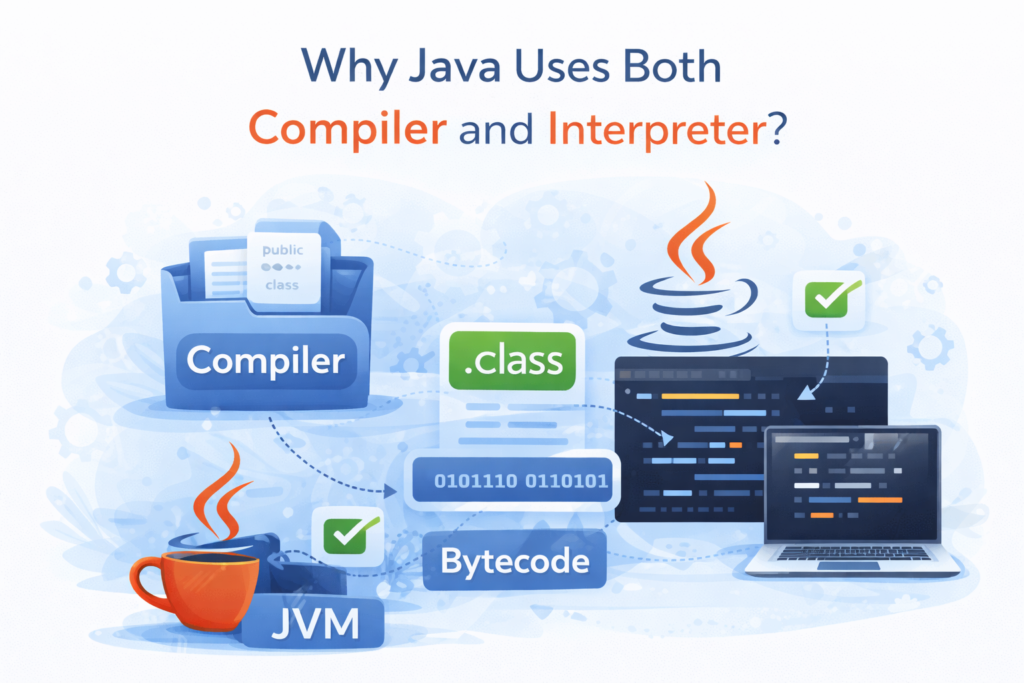
📌 Step-by-Step Process
- Java source code is written in a
.javafile - Java Compiler (
javac) compiles it into bytecode (.classfile) - Bytecode is platform independent
- JVM Interpreter executes bytecode on the target system
- JVM converts bytecode into machine-specific instructions
🧱 Role of the Java Compiler
🛠️ What the Compiler Does
The Java compiler:
- Checks syntax errors
- Converts source code into bytecode
- Ensures code follows Java rules
- Produces
.classfiles
👉 Bytecode is not executed directly by the OS.
📌 Why Bytecode Is Important
Bytecode:
- Is the same on all platforms
- Acts as an intermediate language
- Enables Java’s portability
🧠 Role of the Java Interpreter (JVM)
▶️ What the JVM Does
The Java Virtual Machine (JVM):
- Loads bytecode
- Verifies bytecode for security
- Interprets or compiles bytecode to machine code
- Executes instructions on the system
Each OS has its own JVM implementation.
⚡ Just-In-Time (JIT) Compiler (Advanced Insight)
🚀 How Java Improves Performance
Modern JVMs use a Just-In-Time (JIT) compiler.
JIT:
- Converts frequently used bytecode into native machine code
- Stores it in memory
- Improves execution speed significantly
👉 This makes Java performance comparable to compiled languages.
📊 Comparison: Compiler vs Interpreter vs Java
| Feature | Compiler Only | Interpreter Only | Java (Hybrid) |
|---|---|---|---|
| Platform Independence | ❌ No | ✅ Yes | ✅ Yes |
| Execution Speed | ✅ Fast | ❌ Slow | ✅ Fast (with JIT) |
| Error Detection | Compile Time | Runtime | Compile Time |
| Portability | ❌ Low | ✅ High | ✅ Very High |
| Security | ❌ Limited | ❌ Limited | ✅ Strong |
🌍 How This Enables WORA
🧠 Write Once, Run Anywhere
Java’s hybrid model enables:
- One compiled bytecode
- Multiple JVMs on different platforms
- Same program running everywhere without modification
This is the foundation of WORA (Write Once, Run Anywhere).
❌ Common Misconceptions
🚫 Java Is Interpreted Only
❌ Incorrect
✔ Java is compiled first, then interpreted/executed
🚫 Java Is Slow Because It Is Interpreted
❌ Outdated belief
✔ JIT compilation makes Java fast and efficient
🚫 Compiler and JVM Do the Same Job
❌ Incorrect
✔ Compiler creates bytecode
✔ JVM executes bytecode
🧠 Simple Analogy (Easy to Remember)
📘 Real-World Analogy
- Compiler → Translates a book into a universal language
- Interpreter (JVM) → Reads that language aloud in the local accent
This way, the same book can be read anywhere.
📌 Why This Design Is Ideal for Java
⭐ Key Advantages
- Platform independence
- Better performance
- Strong security
- Early error detection
- Optimized execution
This design is one of the main reasons Java is widely used in enterprise systems and large-scale applications.
🏁 Conclusion
📝 Final Summary
Java uses both a compiler and an interpreter to combine the best features of compilation and interpretation. The compiler ensures platform independence and error detection, while the interpreter (JVM) enables execution on any system.
This hybrid approach makes Java portable, secure, efficient, and scalable, and is a key reason for its long-term success as a programming language.